
Circular Economy and Water: HWP Members Advancing Sustainable Water Solutions through Innovation
Current Challenges
Water is fundamental to economic development, food production, industry, and energy generation. Yet population growth, urbanization, climate change, and increasing industrial demand are placing unprecedented pressure on freshwater resources worldwide. The Ellen MacArthur Foundation projects a significant gap between global freshwater demand and sustainable supply by 2030 if current consumption patterns continue.
Historically, water management has followed a linear model of "take, use, and discharge." Freshwater is extracted, consumed, treated, and released as wastewater. While this approach supported economic growth, it has become increasingly unsustainable in a world facing water scarcity, pollution, and climate uncertainty.
The circular economy offers an alternative. Rather than treating wastewater and stormwater as liabilities, a circular approach views them as resources that can be recovered, regenerated, and reused. This minimizes waste, improves resource efficiency, and creates economic value while strengthening water security.
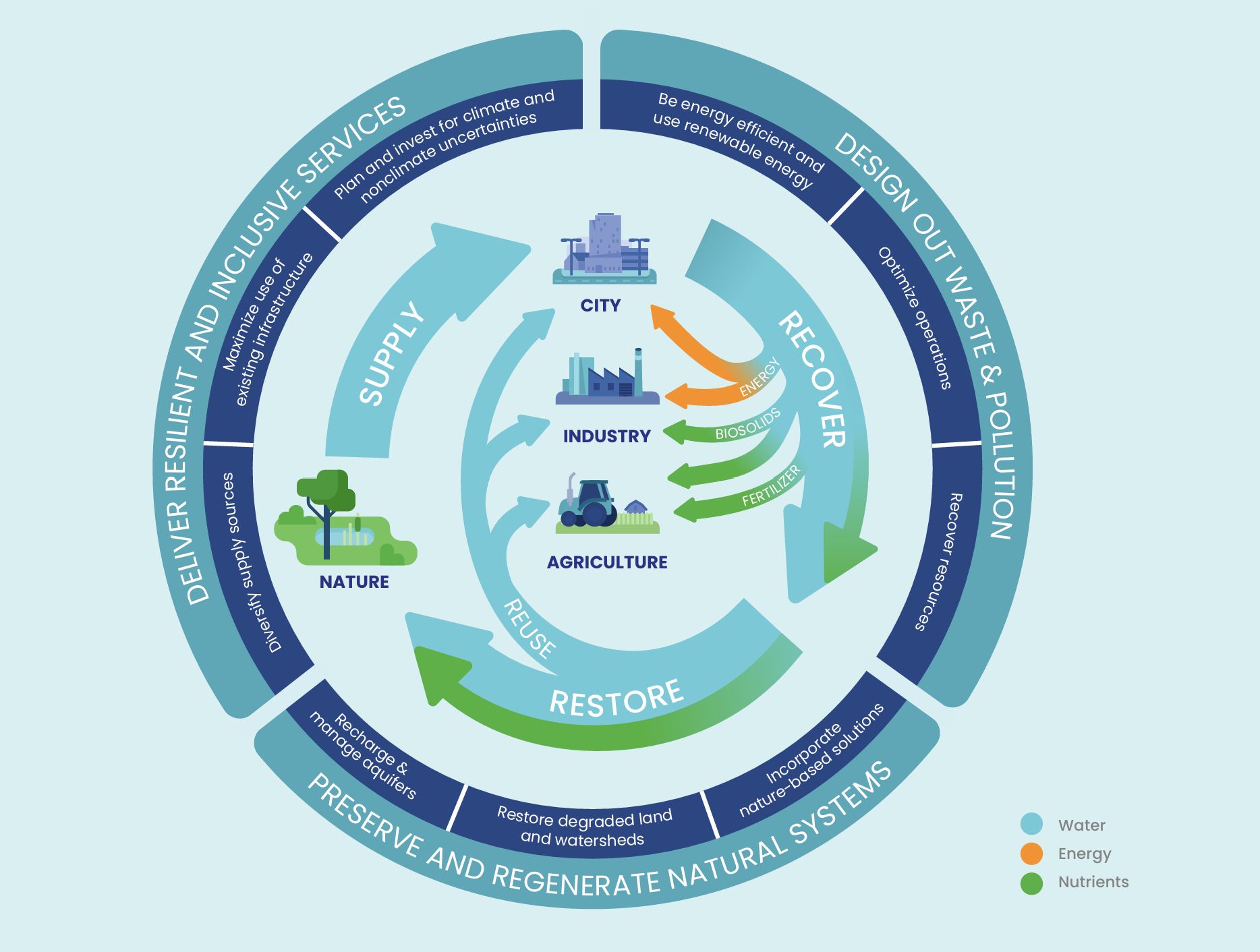
Figure 1: Water in Circular Economy and Resilience (WICER) Framework Source: WATER IN CIRCULAR ECONOMYAND RESILIENCE (WICER) Anna Delgado, Diego J. Rodriguez, Carlo A. Amadei and Midori Makino (2021)
For policymakers, utilities, and investors, the challenge is to achieve three objectives simultaneously: environmental sustainability, economic viability, and equitable access to water services. The Hungarian Water Partnership (HWP), through its Members, contributes to this transition by bringing together Hungarian engineering expertise and innovative technologies that support circular water management.
FEATURE 1 - Resource Recovery and Pollution Prevention
A circular water economy requires moving beyond traditional treatment systems toward resource recovery and pollution prevention. Instead of merely removing contaminants before discharge, modern systems seek to recover valuable resources while protecting natural ecosystems.
One example is Hungarian company Puraset, which has developed regenerable adsorbent technologies for removing contaminants such as iron, manganese, arsenic, and ammonium from water sources. Unlike conventional treatment processes that rely heavily on chemical additives and generate significant waste, regenerable adsorption systems can be repeatedly restored and reused.
This approach supports circular economy objectives by reducing chemical consumption, minimizing waste generation, extending material lifecycles, and lowering long-term operational costs. By increasing resource efficiency and reducing environmental impacts, regenerable adsorption demonstrates how circular principles can be embedded directly into water treatment infrastructure.
FEATURE 2 - Stormwater as a Resource
Circular water management extends beyond treatment facilities to the entire urban water cycle. Urbanization replaces natural landscapes with impermeable surfaces that increase flood risks, reduce groundwater recharge, and transport pollutants into rivers and lakes.
Recognizing these challenges, environmental policies increasingly promote decentralized stormwater retention, treatment, and reuse systems. Pureco specializes in stormwater management solutions that integrate retention and cleansing functions into built infrastructure.
Pureco's systems help reduce pressure on municipal drainage networks, improve climate resilience, protect receiving water bodies from pollution, and create opportunities for stormwater reuse. By retaining and treating rainfall close to where it falls, such solutions contribute to a more resilient and circular urban water cycle.
FEATURE 3 - Policy and Financing for Circular Water Management
The transition to circular water management is supported by policy frameworks such as the European Green Deal, the Circular Economy Action Plan, and the Water Framework Directive. These initiatives encourage water reuse, pollution prevention, resource recovery, and climate adaptation while promoting sustainable infrastructure investments.
However, implementing advanced water technologies often requires substantial upfront investment. If these costs are passed directly to consumers, they may create inequalities in access to safe and affordable water services. Financing mechanisms must therefore balance profitability with social equity.
Several approaches can help achieve this balance. Net Present Value and Cost-Benefit enables decision-makers to evaluate projects based on long-term operational savings rather than initial capital costs alone. Polluter-pays principles and Extended Producer Responsibility frameworks shift part of the financial burden to those generating pollution. In addition, blended finance and public-private partnerships can mobilize public and private capital while limiting pressure on water tariffs.
Circular systems can also create new revenue streams through the recovery and reuse of treated water and other valuable resources, transforming utilities from service providers into resource recovery hubs that support local economies.
Conclusion
The shift from linear water management to a circular water economy is becoming both an environmental necessity and an economic opportunity. As water scarcity, climate risks, and resource pressures intensify, maximizing the value of every drop of water will be essential.
Hungarian innovations such as Puraset's regenerable adsorbent technology and Pureco's stormwater retention and cleansing solutions demonstrate how practical engineering can support circular economy objectives. When combined with supportive policies and innovative financing mechanisms, these technologies can help deliver water systems that are environmentally sustainable, economically viable, and socially equitable.
By treating wastewater and stormwater as valuable resources rather than waste streams, the water sector can create a future where economic growth, environmental protection, and universal access to water reinforce one another.