
From Regulation to Bankable Solutions: HWP Contributes to Africa’s Sanitation Agenda at the 97th AfWASA STC Meetings
The Hungarian Water Partnership (HWP), through its member companies, has been an active participant in Africa’s water and sanitation landscape over the past several years, contributing Hungarian expertise, technologies and practical experience to the development of sustainable water and sanitation services across the continent.
Through projects, professional cooperation and knowledge exchange, HWP has worked closely with utilities, institutions and sector organisations across Africa. More information on HWP’s African activities is available on our African Projects page.
An important element of this engagement has been the development of long-term institutional partnerships. Over recent years, HWP has strengthened its cooperation with key African water and sanitation organisations, including the African Water and Sanitation Association (AfWASA) and the Pan-African Association of Sanitation Actors (PASA/APAA). More information about HWP’s international partnerships is available on our News and Members & Partners pages.
HWP represented at the 97th AfWASA STC Meetings
In July 2026, HWP was once again represented at one of AfWASA’s key strategic professional gatherings, the 97th AfWASA Strategic and Technological Council Meetings.
During the Sanitation Specialist Group session on “Evidence, Regulation and Implementation Pathways for Safe Sanitation Services,” Peter Szabó, member of the AfWASA Sanitation Specialist Group and Head of Engineering at Pureco Ltd., a founding member of HWP, presented a proposal for a new approach to the regulation and standards of Faecal Sludge Treatment Plant (FSTP) effluents in Africa.
The proposed approach recognises that FSTPs should not automatically be regulated according to the same standards as conventional municipal wastewater treatment plants. In many countries, dedicated FSTP effluent regulations do not yet exist, resulting in wastewater treatment standards being applied by default. As discussed during the session, this can result in technically unrealistic requirements, inefficient treatment systems, disproportionately high operating costs and excessive investment needs.
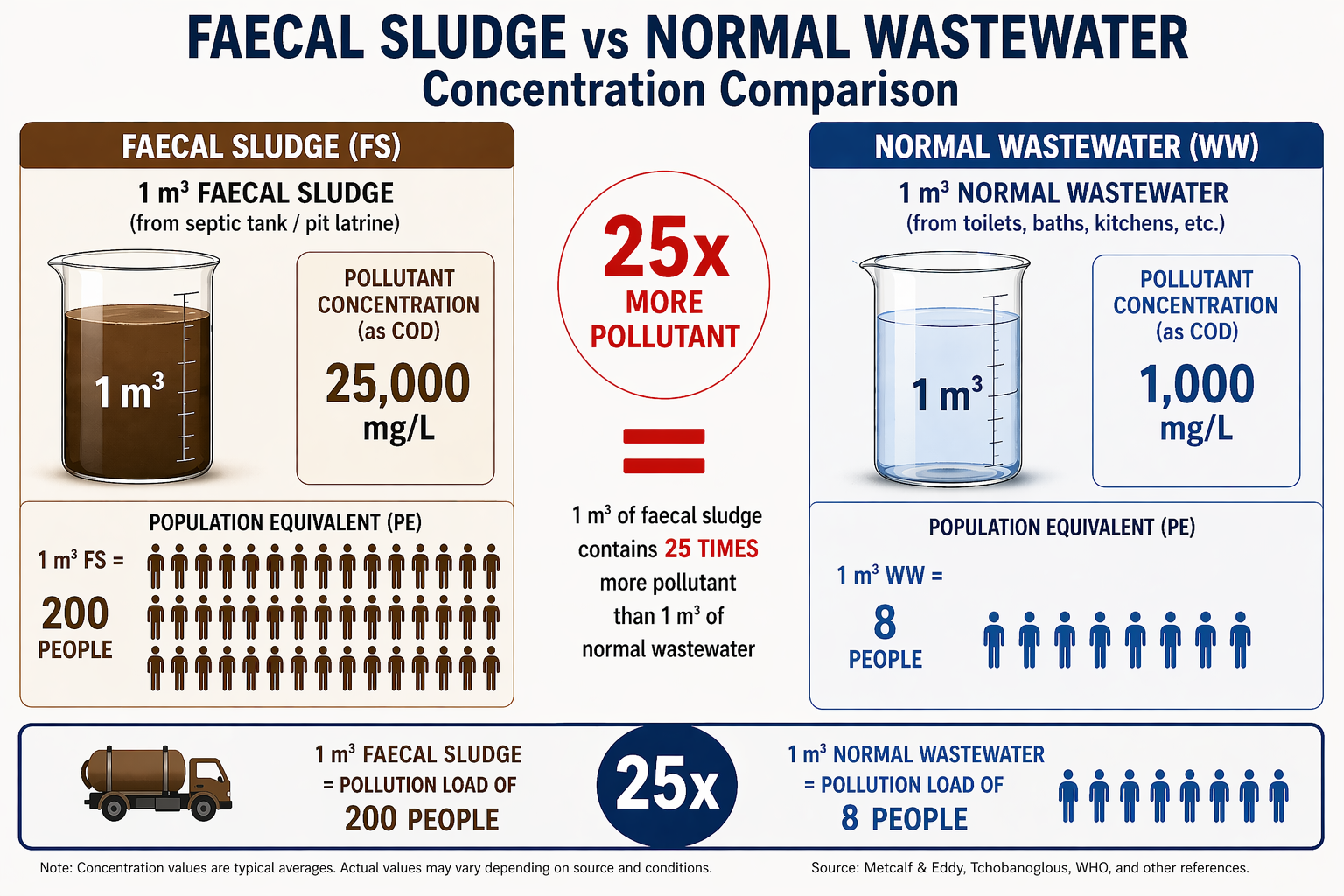
Image created by Péter Szabó (ChatGPT)
The proposed baseline regulation aims instead to create a common but locally adaptable framework and standards.
Importantly, the proposal received the unanimous endorsement of the members of the AfWASA Sanitation Specialist Group, who agreed that it should be submitted as an official AfWASA proposal to the African Ministers’ Council on Water (AMCOW) for consideration within the Africa Sanitation Policy Guidelines.
A wider challenge: building sustainable sanitation service systems
The discussion went well beyond technical effluent standards.
One of the central conclusions of the session was that non-sewered sanitation remains the principal form of sanitation for a substantial part of Africa’s population, yet the sector continues to be insufficiently regulated and institutionally fragmented in many countries. Responsibilities for containment, emptying, transport, treatment, disposal and resource recovery are often divided among municipalities, utilities, regulators, private operators and national institutions without a clearly coordinated service framework.
Participants therefore highlighted the need to increasingly recognise sanitation—including non-sewered sanitation—as an essential service for the public, while creating regulatory structures that also enable professional private-sector participation.
Affordability and financing remain equally important. Safe emptying and treatment services must be accessible to households while operators and treatment facilities remain financially viable. This requires a combination of public investment, concessional financing, targeted subsidies, capacity building and private-sector participation. At the same time, the session emphasised that infrastructure investment alone is not sufficient: facilities must be professionally operated, sustainably financed and integrated into an effective service chain.
Reliable data, institutional capacity and local participation will also be essential. Appropriate solutions cannot simply be transferred from one country to another. Sludge characteristics, climate, settlement patterns, market conditions and institutional capacities differ significantly across the continent, requiring common principles to be translated into locally appropriate technical and business models.
From waste management to resource recovery
The circular-economy potential of sanitation was another important focus of the discussion.
Faecal sludge and wastewater should increasingly be regarded not only as waste streams requiring treatment, but also as potential sources of energy, nutrients and other recoverable resources. Agriculture, biogas and other productive uses can contribute both to environmental sustainability and to the economic viability of sanitation systems.
However, successful valorisation requires more than technology. Solutions must respond to genuine local demand and be supported by appropriate safety standards, quality controls and market-development strategies.
HWP: connecting regulation, technology and implementation
These discussions closely reflect the approach of the Hungarian Water Partnership and its member companies.
For HWP, being present in the water and sanitation sector is not simply a question of supplying individual technologies. Sustainable development requires complex solutions that connect regulation, engineering, financing, operations, capacity building and long-term service delivery.
Through the combined expertise of its member companies, HWP is able to contribute solutions throughout the water cycle—from drinking-water production and network development to wastewater treatment, non-sewered sanitation, faecal sludge management, resource recovery and circular-economy applications.
Our objective is to continue working with African utilities, governments, professional organisations, development institutions and private-sector partners to transform identified needs into technically sound, financially viable and bankable projects.
The work undertaken within the AfWASA Sanitation Specialist Group demonstrates the importance of this cooperation: establishing realistic regulatory frameworks creates the foundation upon which appropriate technologies, sustainable operating models and future investments can be built.
For the Hungarian Water Partnership, this combination of institutional cooperation, practical implementation and the delivery of complex solutions will remain at the heart of our engagement with Africa’s rapidly developing water and sanitation sector.